Showing posts with label Culture. Show all posts

Saturday, March 24, 2012

Hoodies Don't Mean Danger


A question came up Friday night about what hoodies are. The first one i received was cotton fleece gray. It was surplus from World War II and not unlike one my dad brought home from service in the merchant marine.
  They have been part of American life for generations. They do not make anyone suspicious. 
 
 Homeboys wear them, Wiggers wear them, skater boys where them. No athlete, male or female who went to the NCAA tournaments would have traveled without one.

They are seen at soccer games, cheer leading competitions and gymnastics meets. Head out on a Saturday and they are the garment of choice at most coffee shops. Moms pack them in their diaper bags to pull over their infants' onesies if the weather gets cold or wet.

Hoodies have universal utility. they offer protection from the weather, but lack the armor to defend against deadly force. If you ignore the facts of this story, you place the safety of all you care about at risk.

Followed because you look suspicious for wearing a hoodie in March, even in Florida?

Clothes do not make the man. In this case, they did not protect the child.

Sunday, March 18, 2012

Whimsical Worrisome Words


I grew up opposing racism, because I was born in a country that had not come to grips with its own issues about race.

I have been blessed with daughters and granddaughters and wanting the best for them, I speak out against sexism.

As I have gotten older, and seen people of the baby boom generation pushed to the sides in the name of progress, I have become sensitive to agism.

Various  isms are used to divide, desensitize and compartmentalize people. Some people bank on the premise that if you are not part of a group under attack or subject to ridicule, you will not care about such things or might even join in.

I thought long and hard about what I could write about the bumper sticker campaign that attempts to twist the "N-word" in a free-speech protected statement against President Obama's reelection effort.

It has already been labeled racist, but I think it is just a symptom of a broader backlash of bigotry being embraced for political reasons.


There are some who would harness the collective anger of individuals who have somehow convinced themselves that a coalition of formerly underprivileged or disadvantaged classes are out to take away their rights.

If you do not enjoy the same institutionalized advantages that your father or grandfather enjoyed, then you might consider attempts to equalize the rights others as a reduction of your own.

The bumper sticker flap from March 15 triggered some interesting comments, particularly as some people I know tried to get others to at least admit the bumper sticker, the idea behind it and the language used as racist.  They included two responses from the same guy, whom I know is a broadcaster in Texas:

"Ever since 2004, the prevailing sick reasoning is that it's some kind of crime to be a conservative. And we "allow" it by not fighting back." He also said "The thing that bothers me most is this constant barrage from the Left that conservatives are "racist". And yet, I've never seen a more racist person than Al Sharpton. No one calls him on it. He gets the proverbial free pass from the MSM."

I am not clear about the motivation for this feeling of "persecution" as it was put to me. But I have heard it before. It strikes me that this unapologetic conservative is willing to defend the promotion of various isms, by what he perceives as acceptance of isms by the so-called mainstream media and by inference a broader society hell-bent on destroying conservatism.

Could that be just excuse to buy into bigotry?  It's funny that just a few decades after America laughed at the outdated bigotry of Archie Bunker and George Jefferson on popular  TV sitcoms, we now have the far less funny  nastiness of Talk Radio.

The things heard daily on the air provide the angry with outlets to buy into bigotry they that don't get much anymore.


Most people don't go around using words like "honey, baby or sweetie" on the job because they are considered sexist.  Uttering various ethnic, or racial labels that were once commonly heard on the streets of most cities can carry perilous consequences. It is considered tasteless to refer to the physically or mentally challenged as "cripples" or "retards"  today.

 There are now sections in a lot of school systems "codes of student conduct" that make use of many of these terms grounds for discipline.

At many jobs there are policies in place that recognize that such language can create an uncomfortable work environment. People who say them or display them are likely to hear from the boss, the human resources department, or attorneys representing an offended party pretty quickly.

Discouragement of use of the "N-word" is something something some of us have worked for in recent years. These days, we are seeing a backlash from those who likely once used such terms without consequence.
Some smirk smugly through their denials of racism, sexism and xenophobic commentaries.

No matter how often they smile and say "I am not a racist," or "I am not a sexist," or "I am not an agist," the realities of their words, and the tolerance and acceptance of the sentiments means they may be a bigot.

The question is, who will they dislike next, and is that something most of us want to easily accept?


Tuesday, March 13, 2012

Misdirected Anger

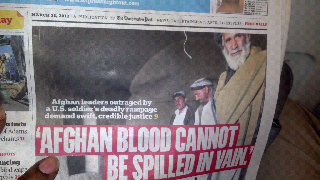
The deaths of 16 Afghan villagers was a tragedy.  That it allegedly occurred at the hands of an American soldier is unfortunate. 

Sad things happen in war, and military doctors and judge advocate office investigators will sort through the reasons why. 

Still, the disturbing backlash of violence now being blamed upon this isolated act is every bit as tragic.

In Afghanistan, Iraq, Pakistan, Libya, Israel, Lebanon, Kenya, France,Turkey, the United Kingdom, Uzbekistan and the United States, terrorist violence has repeatedly been used as a political weapon.  

It moves well beyond the limits of "by any means necessary" to the senseless slaughter of innocents.  Victimizing  civilian populations for political gain is a strategy worthy of universal condemnation.  

NATO and the United States have had successes building alliances with locals willing to hunt down killers who use terror as tools of death and fear. Collateral damage should not be an acceptable means of bringing about change.

The vocal indignation registered by those led would rule Afghanistan is meaningless. They have had years to step and and take control of their country, but corruption and graft have kept them from reaching that goal. Silk robes and posturing politics do not represent power to a people still waiting for basic services.

If the American soldier allegedly involved turns out to be responsible for the killings, he will face justice before a U.S. military tribunal. International security forces maintain the right to discipline their own.

Once the Afghans can handle the security of their own cities, villages and their entire country, they will have the right to subject foreign nationals to justice in their own courts.  For now, that is not only impossible, it is out out of the question.

Universal condemnation of terrorism, and no quarter for those who would target the powerless represents a course that leads toward a more peaceful world.To not negotiate with terrorists is no longer enough.

The threat they represent is ample enough to warrant pre-emptive actions.  It is  why the drones of the United States are armed and continue to strike when intelligence warrants a deserving target. It is a foreign policy approach that is paying dividends. Others in the world should adopt that approach. 


Friday, March 2, 2012

The Real Problem

Rush has said hateful and ignorant things for many years. That his latest rants are earning headlines surely makes him smile.

But it really isn't Rush that is the problem here. He often says things members of his audience think and ardently believe, but lack the nerve or the guts to utter in public.

They declare it entertainment, smile and deny their bigotry, sexism, racism, and intolerance. It is his audience that are the enablers. Their acceptance of his positions perhaps validates the attitudes they do not share in mixed company.

No boycott of sponsors will have much impact because those who would gladly boycott do not listen to his nonsense or buy many of the products advertised on his show or even on the stations that give him airtime.

There are people who smile about each snide attack, laugh at all the sophomoric parodies, and nod their heads as anyone in disagreement is ideologically labeled. They have no need for fact checkers, because the facts cannot get in the way of their narrow beliefs.

The enablers though, have wives, daughters and girlfriends. Presumably they enjoy their relationships with the women in their lives. Many of those women have likely used birth control. Some, likely find the nasty attacks on women and their social independence distasteful and mean spirited.

It is these women who could have influence on Limbaugh's overwhelmingly male audience.  Will they sit quietly as this man makes statements that make most gangster rappers sound tame?   Even on the right, there must be limits.

Then, of course, there are the declared social conservatives. Will they speak out in defense of womanhood, or continue to ignore the nastiness aimed at their sisters, daughters, and divorced or widowed mothers?

Women have ways of making their displeasure known. Politicians could feel the heat at the polls, but Rush's mean and smiling minions may find it kind of chilly at home.  

Wednesday, February 29, 2012

A More Perfect Union

Before the American Revolution people on the colonies would speak of the rights of Englishmen.

The great leap the founding fathers were willing to make with the U.S. Constitution was support of a paternalistic system that did not deem property as the great legitamizer for voting and other privileges.

Germans, Scots, some French, free Africans and varied people of mixed races gained their rights by helping to create this nation.

Still, it took more than a century for women to constitutionally evolve to full personhood. It has taken twice as long for various ethnic, racial, religious and immigrant minorities to approach that status, and for many, it remains an elusive goal.

You do not hear many people who appreciate egalitarian ideals talking about class struggles, reigning in the courts, or restrictions of hard fought and hard won rights.  People who remember being ignored, structurally underserved, and socially subordinated to the privileged do not look back on those times fondly.

The Irish rose out of their service in the Civil War. Women gained theirs through suffrage movements over 50 years, and grew it through liberating actions of the 20th Century. Italians and various Eastern Europeans emerged from  two World Wars with a bit more of it. Jews gained it through horror, hardship and determination.

Negros who became African-Americans and then just black, native Americans from Florida to Texas and New York to Alaska, Asian and Latin American immigrants and the disabled are still fighting for the incremental gains that lead to it. As are those of  those of nontraditional sexual orientations.

I'm talking about the basic right to be an American. It represents full citizenship .The total sum of rights and privileges that add up to no one attempting to limit your opportunities based upon bigotry, professed gender superiority, or other absurd traditions.

If what once was, conceptually represents something unfair, that should never be resurrected.

I cannot imagine my daughters or granddaughters living under the system my mother or grandmothers were forced to accept.  I do not want any of my young people, male or female,  to work in an economy where standing is determined by color, familial relationships or social association.

I won't embrace a time when contraception availability was a political or religious choice decided almost exclusively by men.

So-called social conservatives often speak of returning the nation to how it once was.  What they seem to desire is a vision of America where the will of a fortunate few is foisted on the many.

America's freedoms continue to evolve. Looking backward to a romanticized past does not mean more freedoms for all. Instead, it is a false hopes that somehow, conforming to the visions of a privileged few.

Anyone who thinks back to the pain of those who had to fight for rights and basic freedoms cannot possibly embrace that vision. America moves ahead and gets better as it evolves, those who long for the past want something that is not good for the rest of us.

Policies and  laws limiting any of us, deprive each and every one of us.That is the true and real threat to our freedoms and our democracy. It is not about returning America to anything it once was, it is really about a future no freedom loving person in their rational mind could ever truly want for themselves or for anyone else.


Sunday, February 19, 2012

Why Hate the Government?

Society needs its institutions. There are families,churches,  tribes, towns, cities, states, countries and more. None of those institutions are perfect. People who believe in them work to make them better.

Dissatisfaction with an institution does does not mean it cannot be improved, but few improvements come overnight. You push, prod, inch and drag what is good about it toward something better.  That's one of the reasons the United States has continued to evolve over more than 200 years.

People have looked at where the nation was in their times and worked to make it better. Some of the things that government has done include:

1) Identifying and promoting better farming practices so that the land, crops and livestock we depend upon to feed our families will be able to do the same for future generations. That solved the erosion problems that devastated farm families in the 1920s and 1930s. It also led to the banning of D-D-T and other chemicals that nearly killed off dozens of species in the interests of increasing yields.

2) Beating diseases like smallpox, yellow fever and polio. While private pharmaceutical companies will do some research, coming up with ways to manage, prevent or cure the most crippling diseases has always taken a combination of public institutional research, private sector investment and a good dose of government cash to produce results.

3) Providing basic minimum standards of education critical to the nation's defense, economic competitiveness, and basic cultural identification of what it means to be an American.  While local and state control may be important, sharing concepts on a national scale does play a tremendous role in making sure that people have some basic similarities when they need to function as a unit representing America.

4) Tying the country together so that people from coast to coast, and even in flyover country have access to the same goods, the same technology, and the same services. If you go to certain parts of the eastern United States, you will still find remnants of private  pikes, canals and railways that served portions of a state or region, but withered  because they did not connect to merchants to markets they needed to serve.

5)  Building codes and other safety safety and health standards. If the free market was always the best option, we would still be using leaded gasoline in our vehicles and asbestos in our floor coverings and break linings and lead paint in our homes. The government, through Congress, exercising the will of the people, has brought us many standards that have helped to create a standard of living unrivaled in much of the world.

6) If people were always fair and honest, we would not need to be concerned about human rights. But people have a weakness for acting in their own individual self interests. When people at the local or state level pass ordinances, adopt policies or enact laws that result in institutional unfairness,  government has an obligation to intervene. This is the United States of America so "if you don't like it, move" is just not an option.

So, when people go on the stump and start talking about how government has abandoned or is ignoring the people, they are pandering. In most cases, they do not suggest ways of making government better. Instead they harken to a past time when government was not doing its best by all of its people.

Talk of restoring the nation to its freedoms does not mean the same thing to all people. If you are disabled, elderly, female, an ethnic or racial minority or live outside of the social norm, it could mean a return to exclusions, restrictions or persecutions.

All of these things are part of America's past, yet even now, there are movements to eliminate or minimize their significance in the text books used in the nation's public schools. There are no perfect institutions, like families, countries do not always treat all of their children the same. And like people, acknowledging flaws and working to get better makes any institution stronger.

Don't hate the government or the courts for encouraging change. In the end, only change will make the nation stronger.

Wednesday, February 15, 2012

Political Change

Political change is never easy.  Sometimes there are so-called velvet revolutions where the people in power weigh the risks and simply decide to get out of the way. 

But more times than not, there are demonstrations and protests, followed by riot, terrorist attacks, assassinations and then ultimately, full blown rebellions, revolutions or civil wars.  Add sectarian violence to the mix and you have the chaos that most often brings about significant change. 

A year ago, we had the Arab Spring.  While some longtime leaders fled or accepted house arrest, others fought on, only to face retribution sparked by the anger of their persecuted subjects. 

No one knows how things will play out in Syria.  Bashar Assad is not his father, even if he uses the same tactics.  Whether he can quell a restive population and avoid ouster remains to be seen. 

What other Arab countries are willing to do for the people could influence the outcome, but it could also come down to how many Arab fighters from more than a score of nations opt to join the fray. 
 
In Iran, the Persians in power have their own problems.  Besides a young population weary of the stifling rules of the ayatollahs, there are also outside pressures designed to destabilize the aging regime.The Islamic Revolution was a long time ago, and even still, there are a lot of Iranians inside the country and abroad who wouldn't mind a good dose of western culture. 

In the emirates and kingdoms, there are calls for democracy, women's rights and economic opportunities.  The ruling powerful are rich, but many of the people do not share in the oil and mineral wealth of their countries and are facing high prices and shortages of basic goods. 

When you think about the early years of any nation created or rebuilt following political upheavals the images are the same. Struggle, euphoria, thoughtful efforts at lawmaking, disastisfaction, disillusionment, conflict, destruction, and reconstruction.

In Western Asia, there are nations in varied states of getting there. With so many outcomes now uncertain watchingm waiting and deciding later who to help makes an awful lot of sense.    

Tuesday, February 14, 2012

One Dangerous World

War, terrorism, political famines, acts of God and random crimes. We live in a very dangerous world.

But even if we have to be on guard, most of us still try to live.

No one can know when they could get caught up in events where their very survival will be on the line.

You can drive defensively ans still be involved in a crash; you can eyeball all 150 people who board a crowded train car and still become a victim of collateral damage when and if something happens; you cannot make a storm change course by the force of your will.

But you can decide to live without fear.

For most of my young life I knew governments, the United States, the Soviet Union and others, could blow up the world.

Today the talk about limited nuclear war. Some extremely well armed countries are dealing with internal strife that could spiral into civil wars.

Who ultimately will control their weapons or keep up with their technology is anybody's guess.

We live in a very dangerous world, and while I may think about it, I am much too busy living life to worry about all the possibilities. 

Perhaps we will be here to see tomorrow, but maybe not.

Sunday, February 5, 2012

Pop Goes the Half Time

At 53, Madonna pranced on stage and with multiple costumes and a medley that included segments of 30 years of hits, she pulled off an adequate and safe performance at Super Bowl XLVI.


She promised no wardrobe malfunctions and without a doubt there were no surprises and no more excitement than you might find in an old Busby Berkley musical.

The Material Girl provided some familiar lip synch moves, but this was not a show that warranted many "oh wows!"

There was little to illustrate why she once was a favorite artist on MTV and why songs titled "Like a Virgin," of "Like a Prayer" once aroused controversy among some and passions among others. The lyrics were the same, but the moves were purely rated "G."


She has not aged like Cher, who is now 65, and put her sexiness side by side with Christina Aguilera just last year. While Cher has toned down her look over the years, what she provides is show biz, that like the late Mae West, is classically her own.

Madonna was not Tina Turner at 69, as this picture, taken three years ago, will indicate. Turner is a diva whose moves, curves and voice have all endured maintaining the essence of great beauty worthy of her past sexiness.

 The globe-trotting material girl did not make any moves she would not want her children or even the pope's children to see. Instead, she moved around the stage, going from a black and gold look reminiscent of 1995's New Orlean's Saints Cheerleaders, and ending up draped in Gothic lame' and taffeta.

The Super Bowl Half Time Show has gone for safe entertainment since Janet Jackson's wardrobe malfunction during the half time performance at Super Bowl XXXVIII.

To be sure, Madonna at 53, is not Janet Jackson at 45. But half-time show producers apparently chose to go with a name, the promise of tame and a safe show for Super Bowl XLVI.

Madonna danced, moved and smiled through the requisite 15 minute set. While the songs were once hits, the overall performance was simply a staged production that screamed out "Glee."


Saturday, February 4, 2012

Against Their Interests

 "History repeats itself." That adage is familiar to most of us. It can often explain why people who otherwise should have "no dog in a fight" will risk everything they have by taking up a cause that is not their own.

Terms like "class struggle" and "politics of envy" are being used to paint a curious picture of the wealthiest Americans as victims of some unfair conspiracy designed to strip them of their hard-earned riches.

The logic is that "fair-minded people" will see this as a great crusade to redistribute their wealth and rally to their aid by voting for candidates who won't allow such injustices to occur.

The way the last few years have shaken out, we have expanding poverty and we also have expanding wealth. While the number of poor in this country has grown, the richest Americans have seen their net worth expand.

In the center, is the so-called middle class. Most statistics indicate that they have lost ground. Some of them have slipped back into poverty and others have hung on, marking time and hanging tough against the battering waves of  economic  turbulence.


America has been this way before. History tells us that the Civil War nearly destroyed the union. Ninety years after the birth of the nation, more than 618,000 people died in four bloody years of fighting. Slavery and economics were central causes, and rhetoric about states rights fanned the flames and passions between North and South.

Yet, only 7 percent of southerners owned slaves in 1860. That slave owning class represented perhaps one or two percent of the total population of  the nation. Still millions marched off to war willing do die to defend the rights of a very exclusive club.

Now, as then, we have inflammatory rhetoric, enraged passions, and dramatic struggles for support of divisive causes. On the one hand, there are calls for social and economic justice, on the other, there are  demands that we return to or preserve the values and institutions of the past.

 The nation is gripped by the words, voices and images of politicians, the admonitions and warnings of orators and the harsh realities of economic uncertainty. The world is changing and those who prospered most under the old system seek to maintain or restore it, even as others call out for something more.

In such times, it is the extremists whose voices rise above the fray, but in the end, the decisions rests in the hands of the center, and where they choose to stand and fight when their comforts are at stake.

"Those who cannot remember the past are condemned to repeat it." 
-- George Santayana, U.S. Philosopher, 1865-1952


Friday, February 3, 2012

Pragmatism? Pshaw!

Nancy Brinker built a movement to save lives and honor the memory of her sister. Her idea was simple, "helping women beat the risks of breast cancer is a good." People bought into it and raised tens of millions of dollars.

Somewhere along the line, Nancy Brinker allowed idealogues to divide, and possibly doom her organization. If only for a few days, she turned her back on the poor.

Pragmatism embraces practical solutions without consequences. If you pack a board with people who believe certain things, then they can change the rules, take a vote and end alliances that were crucial to maintaining broad appeal.

In picking funding for Planned Parenthood, or an end run to eliminate it, a faction of the Komen Foundation selected a powerless target. The poor women, very young to premenopausal, who go to clinics offering services at no - to low costs.


Brinker and others did not realize that these women have a reservior of goodwill out here that would not sit silently by as donated dollars were used for exclusive purposes. The money did not come from any one group of people who believe certain ways, it came from lots of people willing to do something for women's health.

The Komen Foundation allowed its intentions and its brand to become  pawns in a political power play. We now live in a time when people, charities and institutions may find themselves offered up for pragmatic reasons. That means that those who would abandon all reason and compromise in favor of any single goal
will roll the dice, consequences be damned.

In this case, they were willing to let poor women, those who lack insurance and generally seek out the only preventive screening and other services within a busline, languish in uncertainty about their health or get sick and die.

There was no talk of alternative care and no true notice that vital breast screening provided at Planned Parenthood would no longer be part of a very fragile safety net.

Pragmatism puts no stake in consequences. It is built on concepts or statements repeated by rote without regard to any waivering thought.

Declare it right, label it just, and disavow anything that falls outside that narrow view. This time it was women and breast screening, last time it was "the poor" and food stamps, or faceless immigrants and a backlash against a 21st century Bracero program.

Pragmatism could lead to protective covenants, discretionary work rules and worse. These are dangerous times, and we should be very concerned about the poor.

 If you are outside the narrow view of pragmatic thought, perhaps you should also be concerned about the rest of us too.


Wednesday, February 1, 2012

Don Knew the Difference

People forget that Soul Train started in Chicago.  It was a city that could support a weekly music show intended for a black audience. It was also a city packed with talent. There were writers, producers, musicians and talented vocalists living there, hanging out and turning out music in phenomenal amounts.

The first guests Don Cornelius had on his show were Jerry Butler, the Chi-lites and the Emotions. A backup group led by a young musician named Maurice White would ultimately evolve into Earth, Wind and Fire.

When it came to music, Don Cornelius knew the difference. While disc jockeys across the country called it R&B, short for rhythm and blues, and most people referred to it as Soul Music, Don Cornelius knew that every city had a style and a sound.

That helped him make Soul Train different from a host of local shows created at the time that never quite caught on, locally and never really had a shot at syndication.  Chicago's Dells were not Cleveland's O'Jays, and Philadelphia's Intruders were not Cincinnati's Isley Brothers.

Don exposed two generations of young people to the sound tracks of their lives. The show provided an escape from chores, Saturday jobs and the stifling sameness of the neighborhoods many of us never left until we headed off for college or the military.

Gut-bucket Blues singers like Joe Simon and Johnny Taylor appeared on the show and sang songs that made their music urban enough to make national charts. Household names like the Temptations and the Four Tops checked their Las Vegas acts at the door and "came home to play just for folks."

Marvin Gaye sang songs, and sometimes even played basketball in outfits that him and Don wore that today's kids would say just looked "young."

When you had to have a huge hit to get any national exposure, Soul Train's syndicated success brought acts into markets from New York and Miami to San Diego and Seattle. The show was never on everywhere, but if you were black and ran into anyone else who was, you could talk about it anywhere.

I doubt that I know anyone who came of age between 1965 and 2005 who never tried to make a fashion statement with something they saw on Soul Train. From Apple Hats to Flagg Brother's boots, or those suspendered hotpants and the ever present Afro picks Soul Train helped define America's vision of black youth having fun.

If you grew up watching fuzzy images on Mississippi televisions from stations in New Orleans, or searched for signals in the rec lounge of some dormitory of some rural college campus on Saturday, Soul Train was not something you wanted to miss.


I could have written about politics, or the economy or this weekend's Superbowl tonight, but February 1, 2012 belongs to Don Cornelius. He knew the difference when it came to music, but he also knew what made us more alike. His idea and his legacy helped define what it meant to be into Black culture for more than 30 years. We will miss him.