Showing posts with label Ignorance. Show all posts

Tuesday, March 27, 2012

The Talk

"You will run into people in these streets who don't give a damn about you."

That is a statement generations of young men heard from fathers, grandfathers, uncles, coaches and male teachers.

It was often the opening statement of "The Talk."  One of those critical life lessons that needed to be verbalize and reinforced in as young males asserted their independence.

It was often followed by reminders that one of a male's greatest obligations to his family was coming home.  Because if he cannot come home he cannot provide for his children or his mother and he cannot defend his sisters.

"The Talk" remains every bit as critical today.  It is the time to cover all those situations where potentially deadly force could mean the difference between survival and tragedy.

Raising our young men to confront all situations directly does not necessarily prepare them for any challenge they might face.

A people conditioned to flourish in a society of oppression only accomplished that by knowing how to assess, think, plan and react thoughtfully to the challenges they encountered in their lives.

In my nearly 60 years, I have known many men who have survived conflicts with those who did not give a damn about them.  I have also seen many families crushed under the grief of deadly violence.

"The Talk" is a memorable conversation many of us had with very wise older men.  They may not have had a lot of schooling, and some might have even been illiterate, but they knew their obligations and they understood the threats.

If we want our young men to one day be old men, some things can not remain unsaid.

Sons, nephews, their friends, and the young men in the lives of our daughters and granddaughters who may not know, or may not hear, it from those who'd mourn their loss the most, need to hear it somewhere.

"You will run into people in these streets who don't give a damn about you." Start the conversation there and then let them know why that matters.

Word, it's what it is!

Sunday, March 18, 2012

Whimsical Worrisome Words


I grew up opposing racism, because I was born in a country that had not come to grips with its own issues about race.

I have been blessed with daughters and granddaughters and wanting the best for them, I speak out against sexism.

As I have gotten older, and seen people of the baby boom generation pushed to the sides in the name of progress, I have become sensitive to agism.

Various  isms are used to divide, desensitize and compartmentalize people. Some people bank on the premise that if you are not part of a group under attack or subject to ridicule, you will not care about such things or might even join in.

I thought long and hard about what I could write about the bumper sticker campaign that attempts to twist the "N-word" in a free-speech protected statement against President Obama's reelection effort.

It has already been labeled racist, but I think it is just a symptom of a broader backlash of bigotry being embraced for political reasons.


There are some who would harness the collective anger of individuals who have somehow convinced themselves that a coalition of formerly underprivileged or disadvantaged classes are out to take away their rights.

If you do not enjoy the same institutionalized advantages that your father or grandfather enjoyed, then you might consider attempts to equalize the rights others as a reduction of your own.

The bumper sticker flap from March 15 triggered some interesting comments, particularly as some people I know tried to get others to at least admit the bumper sticker, the idea behind it and the language used as racist.  They included two responses from the same guy, whom I know is a broadcaster in Texas:

"Ever since 2004, the prevailing sick reasoning is that it's some kind of crime to be a conservative. And we "allow" it by not fighting back." He also said "The thing that bothers me most is this constant barrage from the Left that conservatives are "racist". And yet, I've never seen a more racist person than Al Sharpton. No one calls him on it. He gets the proverbial free pass from the MSM."

I am not clear about the motivation for this feeling of "persecution" as it was put to me. But I have heard it before. It strikes me that this unapologetic conservative is willing to defend the promotion of various isms, by what he perceives as acceptance of isms by the so-called mainstream media and by inference a broader society hell-bent on destroying conservatism.

Could that be just excuse to buy into bigotry?  It's funny that just a few decades after America laughed at the outdated bigotry of Archie Bunker and George Jefferson on popular  TV sitcoms, we now have the far less funny  nastiness of Talk Radio.

The things heard daily on the air provide the angry with outlets to buy into bigotry they that don't get much anymore.


Most people don't go around using words like "honey, baby or sweetie" on the job because they are considered sexist.  Uttering various ethnic, or racial labels that were once commonly heard on the streets of most cities can carry perilous consequences. It is considered tasteless to refer to the physically or mentally challenged as "cripples" or "retards"  today.

 There are now sections in a lot of school systems "codes of student conduct" that make use of many of these terms grounds for discipline.

At many jobs there are policies in place that recognize that such language can create an uncomfortable work environment. People who say them or display them are likely to hear from the boss, the human resources department, or attorneys representing an offended party pretty quickly.

Discouragement of use of the "N-word" is something something some of us have worked for in recent years. These days, we are seeing a backlash from those who likely once used such terms without consequence.
Some smirk smugly through their denials of racism, sexism and xenophobic commentaries.

No matter how often they smile and say "I am not a racist," or "I am not a sexist," or "I am not an agist," the realities of their words, and the tolerance and acceptance of the sentiments means they may be a bigot.

The question is, who will they dislike next, and is that something most of us want to easily accept?


Tuesday, March 13, 2012

Misdirected Anger

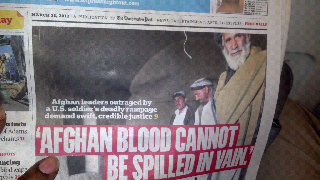
The deaths of 16 Afghan villagers was a tragedy.  That it allegedly occurred at the hands of an American soldier is unfortunate. 

Sad things happen in war, and military doctors and judge advocate office investigators will sort through the reasons why. 

Still, the disturbing backlash of violence now being blamed upon this isolated act is every bit as tragic.

In Afghanistan, Iraq, Pakistan, Libya, Israel, Lebanon, Kenya, France,Turkey, the United Kingdom, Uzbekistan and the United States, terrorist violence has repeatedly been used as a political weapon.  

It moves well beyond the limits of "by any means necessary" to the senseless slaughter of innocents.  Victimizing  civilian populations for political gain is a strategy worthy of universal condemnation.  

NATO and the United States have had successes building alliances with locals willing to hunt down killers who use terror as tools of death and fear. Collateral damage should not be an acceptable means of bringing about change.

The vocal indignation registered by those led would rule Afghanistan is meaningless. They have had years to step and and take control of their country, but corruption and graft have kept them from reaching that goal. Silk robes and posturing politics do not represent power to a people still waiting for basic services.

If the American soldier allegedly involved turns out to be responsible for the killings, he will face justice before a U.S. military tribunal. International security forces maintain the right to discipline their own.

Once the Afghans can handle the security of their own cities, villages and their entire country, they will have the right to subject foreign nationals to justice in their own courts.  For now, that is not only impossible, it is out out of the question.

Universal condemnation of terrorism, and no quarter for those who would target the powerless represents a course that leads toward a more peaceful world.To not negotiate with terrorists is no longer enough.

The threat they represent is ample enough to warrant pre-emptive actions.  It is  why the drones of the United States are armed and continue to strike when intelligence warrants a deserving target. It is a foreign policy approach that is paying dividends. Others in the world should adopt that approach. 


Monday, March 5, 2012

Lest You Be Judged

One thing I learned in thousands of Sundays sitting in lots of pews in lots of places. Most Christians believe that sin is sin. Many Christians believe in original sin. That's the one traced back to Adam and Eve and paradise lost.

There are also mortal sins and venial sins.  Somewhere in the mix are all the lies, thefts, murders, and slights against God, woman and man that most of us could ever imagine.


Still, I have always believed in a forgiving God. A God, who knows exactly what types of imperfect beings he created, and like the best of parents loves us anyway, flaws and all.

As much as I have learned through the years about the separation of church and state and how it is central the democracy in the United States, I am struck by the growing overlap between prayer and politics.

People are being judged, not for the way they live their secular lives, but essentially, how some, who call themselves people of faith believe they should act or live, according to them.

It wasn't long ago, maybe the 1980s, when some folks used to be accused of wrapping themselves in the flag. Back then, it was common to suggest that some people were stronger on defense than others, and even worse, to say some we would roll over for our enemies.

Today, the ranks of the military are filled with the sons and daughters of basic blue collar Americans. Wealthy people do not go there. While the last administration got us involved in Iraq (not to fight terrorism, it turns out) and Afghanistan, the current administration has been tough on Al Qaida and has found ways to make us safer.

Questioning the patriotism of the opposition was bad, but that's become difficult. Still, questioning the faith of many is even worse. It is tiresome to have people speaking out against what they think you may believe, when many do not live what they profess they believe.

Rush Limbaugh is the the pope of the Republican Party. He has awakened a lot of rage in the moderate middle, a very large group of Democrats, independents, and moderate Republicans. This childless man labeled someone's daughter a harlot and a loose woman. Her alleged sin? Offering to share her personal story with Congress as it looked into a woman's health issue.

Many of those of us with daughters were offended by the nastiness of the labeling. Many of us with daughters would go completely off if such attacks were aimed at members of our own families.

I am reminded of Matthew 7, verses 1 and 2. I think it puts it all very clearly:

 "Do not judge, or you too will be judged. For in the same way you judge others, you will be judged, and with the measure you use, it will be measured to you."

So, as this political season continues, and people are tempted to use the ideals they strive for to judge, candidates and voters, think of Ms. Fluke, and remember the words of John 8, verse 7: "Let the person among you who is without sin be the first to throw a stone at her."

Like I said in the beginning, "sin is sin."

Sunday, February 19, 2012

Why Hate the Government?

Society needs its institutions. There are families,churches,  tribes, towns, cities, states, countries and more. None of those institutions are perfect. People who believe in them work to make them better.

Dissatisfaction with an institution does does not mean it cannot be improved, but few improvements come overnight. You push, prod, inch and drag what is good about it toward something better.  That's one of the reasons the United States has continued to evolve over more than 200 years.

People have looked at where the nation was in their times and worked to make it better. Some of the things that government has done include:

1) Identifying and promoting better farming practices so that the land, crops and livestock we depend upon to feed our families will be able to do the same for future generations. That solved the erosion problems that devastated farm families in the 1920s and 1930s. It also led to the banning of D-D-T and other chemicals that nearly killed off dozens of species in the interests of increasing yields.

2) Beating diseases like smallpox, yellow fever and polio. While private pharmaceutical companies will do some research, coming up with ways to manage, prevent or cure the most crippling diseases has always taken a combination of public institutional research, private sector investment and a good dose of government cash to produce results.

3) Providing basic minimum standards of education critical to the nation's defense, economic competitiveness, and basic cultural identification of what it means to be an American.  While local and state control may be important, sharing concepts on a national scale does play a tremendous role in making sure that people have some basic similarities when they need to function as a unit representing America.

4) Tying the country together so that people from coast to coast, and even in flyover country have access to the same goods, the same technology, and the same services. If you go to certain parts of the eastern United States, you will still find remnants of private  pikes, canals and railways that served portions of a state or region, but withered  because they did not connect to merchants to markets they needed to serve.

5)  Building codes and other safety safety and health standards. If the free market was always the best option, we would still be using leaded gasoline in our vehicles and asbestos in our floor coverings and break linings and lead paint in our homes. The government, through Congress, exercising the will of the people, has brought us many standards that have helped to create a standard of living unrivaled in much of the world.

6) If people were always fair and honest, we would not need to be concerned about human rights. But people have a weakness for acting in their own individual self interests. When people at the local or state level pass ordinances, adopt policies or enact laws that result in institutional unfairness,  government has an obligation to intervene. This is the United States of America so "if you don't like it, move" is just not an option.

So, when people go on the stump and start talking about how government has abandoned or is ignoring the people, they are pandering. In most cases, they do not suggest ways of making government better. Instead they harken to a past time when government was not doing its best by all of its people.

Talk of restoring the nation to its freedoms does not mean the same thing to all people. If you are disabled, elderly, female, an ethnic or racial minority or live outside of the social norm, it could mean a return to exclusions, restrictions or persecutions.

All of these things are part of America's past, yet even now, there are movements to eliminate or minimize their significance in the text books used in the nation's public schools. There are no perfect institutions, like families, countries do not always treat all of their children the same. And like people, acknowledging flaws and working to get better makes any institution stronger.

Don't hate the government or the courts for encouraging change. In the end, only change will make the nation stronger.

Friday, February 3, 2012

Pragmatism? Pshaw!

Nancy Brinker built a movement to save lives and honor the memory of her sister. Her idea was simple, "helping women beat the risks of breast cancer is a good." People bought into it and raised tens of millions of dollars.

Somewhere along the line, Nancy Brinker allowed idealogues to divide, and possibly doom her organization. If only for a few days, she turned her back on the poor.

Pragmatism embraces practical solutions without consequences. If you pack a board with people who believe certain things, then they can change the rules, take a vote and end alliances that were crucial to maintaining broad appeal.

In picking funding for Planned Parenthood, or an end run to eliminate it, a faction of the Komen Foundation selected a powerless target. The poor women, very young to premenopausal, who go to clinics offering services at no - to low costs.


Brinker and others did not realize that these women have a reservior of goodwill out here that would not sit silently by as donated dollars were used for exclusive purposes. The money did not come from any one group of people who believe certain ways, it came from lots of people willing to do something for women's health.

The Komen Foundation allowed its intentions and its brand to become  pawns in a political power play. We now live in a time when people, charities and institutions may find themselves offered up for pragmatic reasons. That means that those who would abandon all reason and compromise in favor of any single goal
will roll the dice, consequences be damned.

In this case, they were willing to let poor women, those who lack insurance and generally seek out the only preventive screening and other services within a busline, languish in uncertainty about their health or get sick and die.

There was no talk of alternative care and no true notice that vital breast screening provided at Planned Parenthood would no longer be part of a very fragile safety net.

Pragmatism puts no stake in consequences. It is built on concepts or statements repeated by rote without regard to any waivering thought.

Declare it right, label it just, and disavow anything that falls outside that narrow view. This time it was women and breast screening, last time it was "the poor" and food stamps, or faceless immigrants and a backlash against a 21st century Bracero program.

Pragmatism could lead to protective covenants, discretionary work rules and worse. These are dangerous times, and we should be very concerned about the poor.

 If you are outside the narrow view of pragmatic thought, perhaps you should also be concerned about the rest of us too.


Thursday, January 26, 2012

Consider the Foundations of Your Beliefs

I believe most people are predisposed to be good, social and caring. I don't think it is a naive point of view, because I understand that if people are led to believe that certain outlooks are acceptable, they will adopt that point of view.

When you teach a child, you repeat what you want them to learn again and again, and over time, they repeat it to you. Then you reinforce the image or action with words that best represent the concept and the meaning is imprinted.

This is what has been going on since Nov. 4, 2008. "If we never refer to 'him' as President Obama, he will never really be president."

There are people in this country who have dealt with the last election as though it were a bad dream. They want to believe that since Jan. 20, 2009, there has been no one in the White House and no one running the United States.

This is the fiction that has made it so easy for people named Wilson, Sensenbrenner and Brewer to get headlines over the past few years. Their actions have left lasting impressions, constantly reinforced by angry pundits, writers and in conversations held beyond the earshot or those warranting language that was "politically correct."

One thing Ihave learned in more than 40 years of being in the news business: Headlines make Page One and last forever.  Apologies are buried somewhere beyond page three and never receive the same attention.

I also know that for decades, no one confronting  a sitting president at any event ever got within fingerpointing distance of the leader of the Free World. These types of sad activities will forever change the nature of the U.S. Presidency.

By talking about the physique of the First Lady or suggesting for a moment that Brewer “felt a little bit threatened, if you will, in the attitude that he had,” is to play up to the basest stereotypes of the past.

This is likely to be significant as we head into the election cycle of 2012. Already, Newt Gringrich has been admonished for rattling the sensibilities of our Cubano cousins. I have said in recent days that the basest natures of "Willie Horton racism" will play out in the months ahead.

What I can tell you is that many people have been desensitized to racism and classism since 2008. They have been conditioned to believe that finger pointing, blaming and labeling is natural, normal and acceptable. Perhaps reminding them of what they are willing to accept as truth, could jar them back to reality.

Anger, distrust and resentment have become so ingrained that they are considered, normal and natural.Even as their parents came around to the inequity of those concepts as they existed in the past, perhaps they need to be reminded of the unfairness of it all. Should we have to fight the battles of the last generation again, simply because we are silent?

Inside, if the people accepting all of this believe in Jesus, and the fundamental truth that God created all men equal, can they really believe that anything like this could ever be acts of Christian kindness?

Perhaps there is more than the souls of political parties hanging here in the balance.


Friday, January 13, 2012

Lawyers Can't Do Everything

Lawyers have had a role in elections for decades, but ever since the presidential election of 2000, their role has been totally blown out of proportion.

For many years, they have been on hand to help ensure voting rights, for at least ten years, they have been stationed at polling places to discourage voting.  Assertive speech and accusations can chill the participation of some voters who don't particularly trust the legal process.

Now, some candidates who somehow never got around to building basic political organizations, have been trying to use lawyers to force their way onto the ballots in several states.

Even when people traveled by wagon and coach, somehow they managed to build support across the country to give themselves a shot at winning their parties' nominations. 

To circumvent the basics of politics is an insult to those who dedicate their time and resources to the system. Voters show up on election day, policy wonks and party activists move from one election cycle to the next with only a few days off. They are the people who prepare the nation for elections yet to come.

Everything from poll challengers to paid canvassers and court petitions designed to challenge qualification requirements are measures aimed at corrupting the system. It is sad that respect for the process has been tossed on the trash heap.

It's doubtful I will add to this blog this weekend. I will be celebrating the Martin Luther King Holiday weekend. For those of us who are passionate about civil rights, it commemorates something very special.  As I wrote this week in a basic tweet, "Nothing changes a person's mind about _rights protections more quickly than having theirs ."

This is something many of my conservative friends don't seem to understand. Many of my other friends are of a generation that still remembers life without basic #equal_protections.
This is what makes the  #MLK_holiday and the memorial on the National Mall so important.

It took court rulings to force the issue of equal protection in commerce and accomodations. Then Congress wrote laws codifying it to remove the ambiguity for the public. And in the intervening years, the people have gradually come to accept the basic fairness of what the law requires.

I will leave challenging the basic nature of conservative ideology for another day, but I will leave you with this thought. 

If the ethos of America is the equal value of each of its people, then why rail against any laws passed with intent to ensure equal protection? Is it not human nature that keeps each man or woman from being measured equally?


Sunday, January 8, 2012

Standards and Principles

Let's See. Jeremiah Wright, Louis Farrakhan, Tawana Brawley.  These are all names that have  come up for years in discussions about the politics of Barrack Obama, Jesse Jackson and Al Sharpton.  Politics can be a very unforgiving process.
People weigh your past voting records and statements. They examine your relationships ans associations. And they consider the actions of your family, your business associates and your high-profile supporters.

When you have to campaign in 50 states and five territories, everything you say, do or ever have done could have a shelf life.   People will remember insensitive positions you've taken against women or minorities. They will also remember your appearances made before or on behalf of organizations and institutions and your associations with individuals.

So, if Jeremiah Wright, Louis Farrakhan and Tawana Brawley can be forever linked to some politicians, then surely other politicians should face similar scruitiny. If public denouncements and repudiation are so critical to vindication, then perhaps such demands should be universally applied.

Would that not be holding everyone to the same standards?  Wouldn't that make clarifying where candidates stand on issues such as bigotry a matter of principle?


Monday, January 2, 2012

Shhhh The News is On


Remember when there were just three television networks and we saw the world in black and white? Most people only had one television in their homes and the radio in the car was AM only.  Still, it seemed like everybody, from housewives and janitors, to secretaries and factory workers shared one thing with their bosses. 

They read two newspapers a day Monday through Friday, at least one on Saturday and one on Sunday. Besides the morning and evening papers, that were gently read and refolded for respected adults who couldn't see them until later, there were ethnic papers that offered thoughtful and focused perspectives.

The people we depended on also heard real news on the radio.Whether they had limited or no education or the benefits of college and more, they got a view of the nation and the world that could never be gleaned from those rare long-distance calls to distant relatives who lived in other parts of the country.

Generations of children grew up understanding that news was information, even if it was less than complete. If it was slanted in one direction or another, having some information was so much better than being ignorant.

I remember sitting there quietly with my brothers or cousins and watching grainy film that was often days old, as middle aged men and their white male reporters offered their observations about world events. If you were anywhere on the block, you were expected to be there when the news came on.

The stories might be fodder for dinner table conversation, or something to be discussed between parents and their friends or siblings after Sunday dinner. I grew up thinking it was necessary and natural to know something about the world beyond my neighborhood.

Today, there may be fewer newspapers and quality radio news is something you have to search for, but national and international news is a 24/7 packaged product. It is presented in living color and nearly as instantly as it occurs.

Yet, children and many adults seem clueless about world events. Ask five of them individually, for the last names of three of the Republican presidential hopefuls and three may have a hard time coming up with right answers. Ask them if Americans are still fighting in Iraq and they may not know we left in December.  Ask them what's going on in the world and they may smile and tell you the NBA lockout is over.

I wonder what would happen if we tried a little something different. Instead of doing what our grandparents would do which was to hush us up and offer the look that meant "park it and learn something,." we tried an instructive but abrupt  approach.

It might be something like this "Don't leave, 'Sit down now, and shut up, the news is on! It's your world, you might learn something." 

DeHoll-- My World, My View, 01-02-2011